
Remembering Charlie Kirk: A Life Cut Short, But a Legacy That Endures
Remembering Charlie Kirk: A Life Cut Short, But a Legacy That Endures
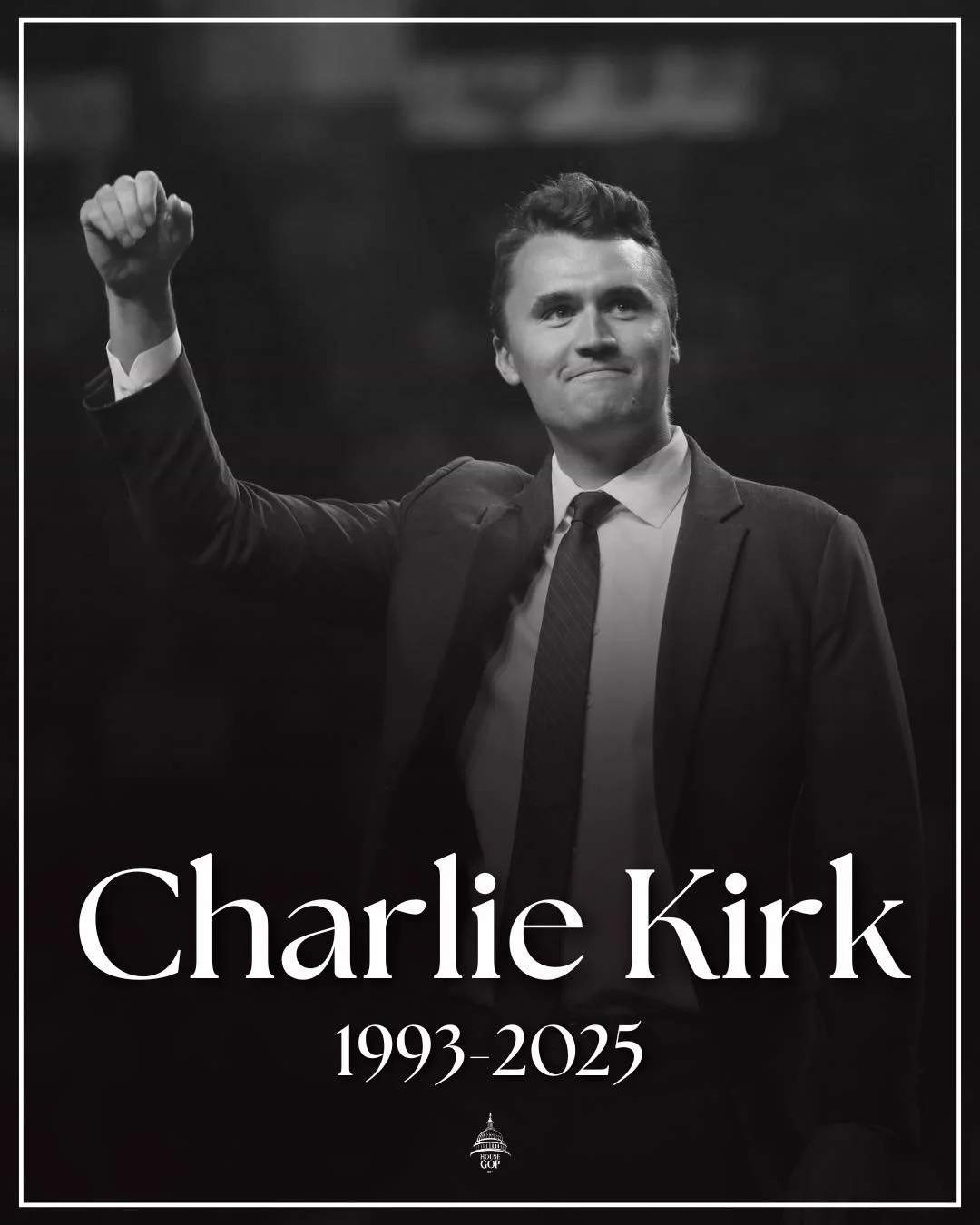
The news of Charlie Kirk's death on September 10, 2025, struck like a thunderbolt across the conservative world and beyond. At just 31 years old, the founder of Turning Point USA was fatally shot during an event at Utah Valley University in Orem, Utah. What began as a routine campus speaking engagement, where Charlie fearlessly engaged young minds on issues of freedom, faith, and the future, ended in unimaginable tragedy. My heart aches for his wife Erika, his two young children, his family, his close friends, and the countless followers who found in him not just a voice, but a guiding light. To those inspired by his courage to fight intellectually for his convictions, we grieve with you. Charlie's absence leaves a void, but his spirit calls us to carry on with the same boldness and grace.
As a moderate Republican, I've often found myself in respectful disagreement with Charlie's more fervent takes. Yet today, those differences fade into the background. Charlie was an evangelical Christian and ardent MAGA supporter, two vibrant factions within our party that have sharpened the edges of our moderate caucus through contrast and debate. He challenged us to defend our shared principles more fiercely, reminding us that the Republican tent is big enough for passion and pragmatism alike. More than anyone, Charlie highlighted the unifying principle binding all Republicans, an unwavering belief in America's promise. He championed capitalism as the engine of opportunity, portraying the United States not as a flawed experiment, but as a nation of inherent goodness, populated by good people striving for better.
Charlie's lens on history was a masterclass in optimism amid cynicism. He exposed how America's story, a tapestry of progress and triumph, was being exploited and reframed in negative light by those with ulterior motives. Whether it was curricula in schools or partisan media narratives, Charlie called it out, urging us to reclaim our heritage as one of resilience and redemption. His message of personal responsibility and self-empowerment resonated deeply, reject the seductive trap of victimization, he implored, for it erodes the confidence and mentality of those who need inner strength the most, our youth, our working families, and our dreamers. In a culture quick to assign blame, Charlie empowered individuals to rise, take ownership, and build lives of purpose. For that, Republicans, and indeed the nation, owe him an eternal debt of gratitude.
Charlie's influence in the online and social media arena was unmatched, even among a constellation of formidable voices. Jordan Peterson's profound psychological insights, Ben Shapiro's razor-sharp fact-checks, Dave Rubin's civil dialogues, Michael Knowles's witty cultural critiques, Matt Walsh's unflinching documentaries, Steven Crowder's irreverent humor, Patrick Bet-David's incisive policy breakdowns, these influencers have collectively waged and won intellectual battles for Republican ideals. They've armed us with arguments, memes, and moments that cut through the noise. Yet none rivaled Charlie's singular impact. His work ethic was legendary, crisscrossing the country, building Turning Point into a powerhouse that mobilized millions of young conservatives. His debates were a clinic in preparation and poise, knowledgeable, skilled, and always rooted in conviction. Charlie didn't just argue, he challenged us to deepen our knowledge, think more critically, and articulate the truth we hold dear with greater clarity and fire. He inspired a generation to not just consume ideas, but to champion them.
In the wake of this loss, a regrettable finger-pointing has erupted between Republicans and Democrats over whose voter base is more prone to violence. Democrats point to the January 6th 2021 attack on the US Capitol, the October 2022 attack on Paul Pelosi, the April 2025 arson attack on Pennsylvania Gov. Josh Shapiro's residence, the June 2025 shooting of Minnesota State Senator John Hoffman and his wife followed by the assassination of former Speaker of the Minnesota House of Representatives Melissa Hortman and her husband by a gunman disguised as a police officer who went to multiple elected-officials’ homes on the same night.
Republicans counter with examples of the two assassination attempts on President Donald Trump in 2024, the July 4th, 2025 coordinated attack on an ICE detention center in Texas where officers were drawn outside and fired upon by gunmen in the nearby woods hitting an officer in the neck and leaving him in critical condition, the fire bombings at the New Mexico GOP offices, as well as the 2017 congressional baseball shooting that nearly killed House Majority Leader Steve Scalise, or the 2022 attack on Justice Brett Kavanaugh's home.
Both GOP and Democratic Party leaders have repeatedly denounced these acts, and violence in all forms in the name of politics or otherwise. However, while both parties contain fringe elements with higher propensities for extremism, and both parties bear responsibility for stoking fear that can compel the unstable to violence, it would be dishonest to frame the harboring of violence as equal between the parties.
Charlie, his followers, other Republican influencers, and mainstream Republican thought all take an explicit pride in the commitment to open dialog and debate as a peaceful means of resolving differences. Meanwhile, the path of leftist ideology, a sizable faction in the Democratic Party, has veered alarmingly from "hate speech is not free speech," which demanded government curbs on offensive expression, and support for government compelled pronoun mandates, to equating offensive words with physical harm and rationalizing violence as a countermeasure to opposing views. This paved the way for Antifa and other leftist protesters to physically block conservative events on college campuses, using threats, shouts, and force to silence speakers like Ben Shapiro or Milo Yiannopoulos.
After Luigi Mangione's cold-blooded murder of UnitedHealthcare CEO Brian Thompson on December 4, 2024 in New York City, Mangione received hordes of fan mail in prison supporting his actions, his praise and adoration went viral on social media, “Free Luigi” rallies took place outside his court proceedings, a crowdfunding effort supporting his legal defense raised more than $500,000, a state ballot initiative was filed in California titled, "The Luigi Mangione Access to Health Care Act.” I personally heard several non-fringe Democrats argue that the interstate manhunt for Mangione was driven by the victim's wealth rather than the crime's gravity and that if they had spotted Mangione post-act, they wouldn't have turned him in, perspectives appearing in Reddit discussions and other community posts. A December 2024 Economist / YouGov poll found that 21% of adult US citizens viewed Mangione favorably or somewhat favorably, while a staggering 39% of 18-29 year-olds viewed Mangione positively. The study didn’t provide political affiliation data, however, the underlying associations are well-understood. Even an MSNBC article expressing opposition to the support for Mangione stated, “this is no longer a fringe sentiment – it’s a mainstream one.”
The actions of Tyler Robinson, Charlie Kirk’s apparent shooter, mirror this chilling pattern. The 22-year-old inscribed antifascist slogans, commonly used in Democratic protests against MAGA, on the shell casings of the bullets used in Charlie's killing, just as Mangione had done. A member from Robinson’s Discord group, while joking about Robinson as the "proposed shooter," jokingly warned, "Do not go into a McDonald's," a direct reference to Mangione's arrest at a Pennsylvania McDonald's after the Thompson murder.
Robinson, who was in a relationship with a transgender partner, reportedly viewed Charlie's stance on transgender issues as disseminating hate; however, Charlie's views were often distorted and weaponized because they clashed with progressive orthodoxy. Charlie's viewed sex and gender through a lens of biological reality, under which men cannot become women or vice versa. He believed that conflicts between the mind and body should be addressed by affirming the mind's alignment with God's creation and that every human body is beautiful as crafted by the Divine. He advocated for growing comfortable in one's born form, emphasizing self-acceptance over surgical alteration. Both his viewpoint and the manner in which he argued it, were worlds apart from hate.
Amid the grief of Charlie’s loss, conspiracy theories have festered online with accusations of multiple gunmen or the involvement of foreign state actors. Let's dispense with the false narratives, the overwhelming evidence points squarely to Tyler Robinson acting alone. Videos capture his car parking in a nearby neighborhood, him walking to campus with an apparent weapon concealed beneath his clothing, appearing on campus, fleeing the scene and leaping from the rooftop, walking into woods where his rifle, bearing his DNA, was recovered. Text messages to his partner, online friends, and family, who ultimately turned him in, all confirm the case. A pending trial will lay bare every detail, but unfounded claims dishonor the truth-seeking Charlie embodied.
Charlie’s death is a clarion call to reject violence, embrace vigorous debate, and recommit to the republic he loved. In honoring him, let us build bridges where others burn them, because America's story isn't over, it's ours to triumphantly continue.